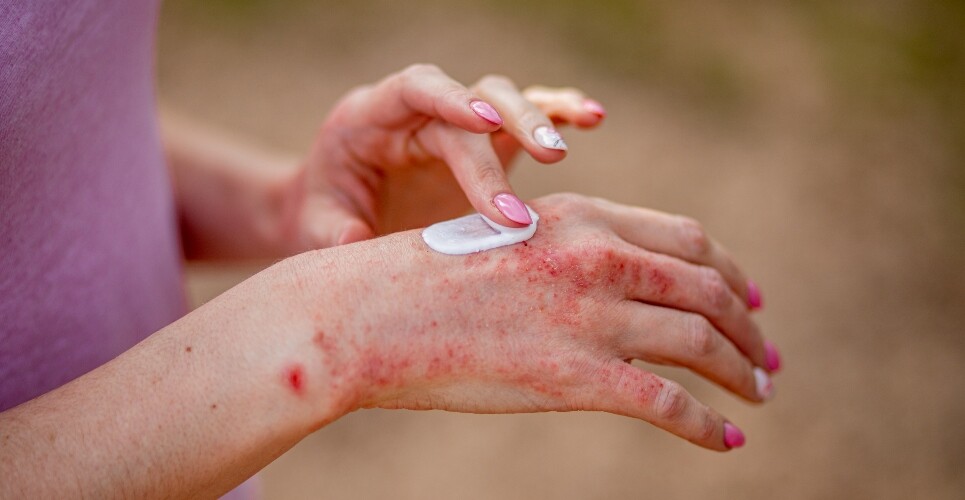
Patients with moderate-to-severe chronic hand eczema often respond poorly to topical corticosteroids or are unable to use them, according to a recent retrospective study that underscores the limited availability of effective, well-tolerated topical treatment options.
The Real-World treatment & mAnagement of chronic hand eczema in cLinical practice study reviewed medical charts from Canada, France, Germany, Italy, Spain and the UK examined real-world treatment patterns in adults with moderate-to-severe chronic hand eczema.
Data was analysed from 292 physicians covering 1,939 patients, 53.6% of whom were female, with a mean disease duration of six years. Over the preceding 12 months, physicians judged disease severity to have been moderate in 56.8% and severe in 43.2% of patients.
High reliance on topical steroids in chronic hand eczema
Nearly all patients (99.1%) received topical corticosteroids (TCS), mainly of medium-to-high potency. The remaining 0.9% were unable to use these due to known contraindications.
However, 39.9% had either an inadequate response or contraindications to TCS including 27.4% who progressed to phototherapy or systemic agents, 12.1% who experienced adverse events or failed to maintain low disease activity despite using high- or ultra-high-potency TCS, and 0.4% with contraindications alone.
Despite being a first-line therapy for chronic hand eczema, the effectiveness of TCS appeared limited. Physicians reported treatment achieving low disease activity in 45.5% of treatment observations, while 31.5% failed to maintain disease control and 20.7% were affected by poor adherence.
Adverse events were recorded in 10.1%, with low-potency steroids associated with the highest rates of reported side effects.
Among all patients, 11.1% received traditional oral systemic therapies such as methotrexate or cyclosporine, 6.8% received alitretinoin, 8.0% biologics, and 1.7% oral Janus kinase (JAK) inhibitors.
In the subgroup requiring escalation to phototherapy or systemic treatment, the highest line of therapy was a biologic in 29.2%, traditional orals in 33.3%, alitretinoin in 22.8%, oral JAK inhibitors in 5.1%, and phototherapy alone in 9.6%.
Treatment patterns were similar between moderate and severe chronic hand eczema within this subgroup.
Study limitations and future directions
The researchers highlighted several limitations, such as dependence on physician judgement for evaluating disease severity and treatment response, the potential for recall bias inherent in retrospective chart reviews, and sampling based on physicians recruited through online panels, which may limit representativeness.
Missing details on reasons for inadequate response and incomplete data on treatment duration also hindered interpretation, they said.
Looking ahead, the researchers highlighted the need for non-steroidal topical treatments specifically developed for chronic hand eczema, particularly given the limited long-term efficacy and tolerability of current options.
However, they concluded that treatment patterns may already be changing following the recent approval of the topical pan-JAK inhibitor delgocitinib and called for future real-world studies to assess its effectiveness in routine practice.
Reference
Gimenez-Arnau A et al. Physician-reported treatment patterns in moderate to severe chronic hand eczema: the RWEAL multinational medical chart review. Dermatol Ther (Heidelb) 2025;15:3577–92.
This article was originally published by our sister publication Hospital Healthcare Europe.