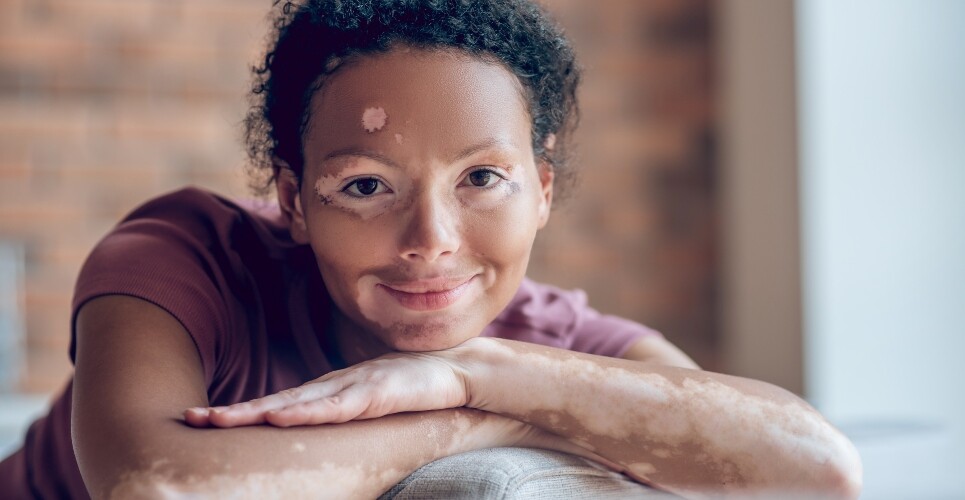
With the launch of the first vitiligo registry in the UK underway as part of the VIRTUAL-UK pilot study and the recent approval of ruxolitinib for use on the NHS, Associate Professor Viktoria Eleftheriadou speaks to Helen Quinn about the rollercoaster trajectory of the vitiligo treatment landscape in recent years, what the registry will mean for clinical practice and her hopes for the future management of this silent and neglected disease.
Vitiligo is a common skin disorder that leads to depigmentation and affects around one in 100 people worldwide. Beyond its physical effects, the disease can have a profound impact on patients’ mental and emotional wellbeing.
Until recently, treatment options for vitiligo remained limited as last summer the National Institute for Health and Care Excellence (NICE) declined to approve topical ruxolitinib for people with non-segmental vitiligo on the NHS. Despite evidence of clinical benefit in trials, this meant that the cream was only available through private prescription, leaving most people with few effective treatment options.
Having treatments that were clinically proven and widely available elsewhere frustrated Associate Professor Viktoria Eleftheriadou – one of the UK’s only specialists with a PhD in vitiligo – a disease she describes as ‘silent’ and ‘neglected’.
However, on 24 February 2026, ruxolitinib was recommended in final draft guidance by NICE and is now the first licensed treatment for vitiligo available on the NHS.
It is indicated for the more than 80,000 individuals aged 12 years and over who have non-segmental vitiligo with facial involvement and for whom other topical first-line treatments have not worked or are not suitable.
This approval, along with the establishment of a new vitiligo registry is bringing new hope to people with this common skin disorder.
Unmet need in vitiligo
Associate Professor Eleftheriadou currently works as a consultant dermatologist at both Walsall Healthcare NHS Trust and The Royal Wolverhampton NHS Trust, where she leads the vitiligo clinical and research centre – or Vitiligo CARE for short. Alongside this, she is also an associate professor of applied health research at the University of Birmingham, and much of her clinical and academic work is dedicated to vitiligo.
‘I always knew I wanted to do dermatology, and vitiligo stuck with me,’ she says. ‘Fifteen years ago, it was quite a neglected disease; there wasn’t much interest around it. I found it interesting, because it’s not a rare disease.’
While individual dermatologists currently keep their own descriptive patient databases, there is no national registry for vitiligo. And so, with limited treatment options and research lagging, Associate Professor Eleftheriadou is working to build a national registry of vitiligo patients across the UK.
This new Vitiligo RegisTry for adUlts And children, known as the VIRTUAL-UK, forms part of a pilot study led by Royal Wolverhampton NHS Trust in collaboration with the British Association of Dermatologists.
Led by Associate Professor Eleftheriado, the study will examine how well current and emerging treatments work for both adults and children with vitiligo, assessing not only safety and effectiveness but also their impact on patients’ quality of life.
Difficulties quantifying vitiligo impact
In 2023, the UK’s Medicines and Healthcare products Regulatory Agency approved ruxolitinib for the treatment of non-segmental vitiligo in adults and adolescents.
‘That was a milestone, it was something amazing that happened in vitiligo, we finally had a licensed treatment,’ Associate Professor Eleftheriadou recalls.
Despite ruxolitinib being the first licensed medicine for vitiligo in the UK, NICE did not approve it for use on the NHS last year, even after an appeal.
‘There wasn’t an issue whether it actually works or not. It was mainly down to the cost; it’s an expensive cream,’ she says. ‘Essentially, when you use wrong scales to show the impact of the disease, then the cost-effectiveness benefit doesn’t show to be as great.’
Vitiligo is a particularly challenging disease to treat because it does not cause usual symptoms. ‘It’s one of those diseases I would call silent, because patients are suffering in silence. They don’t itch, they don’t have pain, per se; it’s all internal. It’s difficult to quantify that,’ she adds.
For some patients, the psychological burden of vitiligo can be profound, contributing to depression, anxiety and even suicidal thoughts. When patches can be concealed, many choose to hide their disease for fear of stigma and, in some cultures, vitiligo can lead to social exclusion, including restrictions on marriage or reason for divorce.
‘There’s emerging evidence that it’s not only the psychosocial impact of vitiligo, but it’s also people with vitiligo being discriminated against, even in jobs, it’s quite shocking. It has effects on multiple levels of a person’s life,’ Associate Professor Eleftheriadou says.
The need for the vitiligo registry
Three oral systemic treatments for vitiligo are currently nearing the end of phase 3 trials, although it remains unclear which will ultimately receive regulatory approval. Associate Professor Eleftheriadou is confident, however, that at least one will progress to licensing, prompting a further NICE appraisal and potential availability on the NHS.
‘There’s a lot of activity happening in the research area here. These three studies are finishing imminently, and that will bring us a situation where we have different medications for vitiligo, which we know have worked in previous smaller studies,’ she explains.
Once clinical trials are completed and treatments are approved, the next challenge will be understanding how they perform in real-world clinical practice. Vitiligo treatment is often prolonged, with many patients undergoing years of treatment.
‘We need data from these new drugs and phototherapy to compare in the real world, to see which might be more effective for specific groups. And to look into the side effects and long-term safety of all these medications, which are coming on the market very soon and hopefully will be available to our patients,’ Associate Professor Eleftheriadou says.
This is why the new VIRTUAL-UK registry is essential. As the UK enters a phase in which vitiligo patients will have access to multiple treatments, there is a need to understand them better.
‘We thought that it was time to do it from the beginning, before you have all these drugs on the market,’ she explains. ‘It’s good to capture everything early, and to be able to then develop recommendations and guidelines.’
The VIRTUAL-UK trajectory
The VIRTUAL-UK pilot study is supported by the National Institute for Health and Care Research (NIHR), and with six centres already having expressed interest, patient recruitment is scheduled to begin in early 2026.
The first two years of the study will serve as a pilot phase. Patients will attend their usual clinics and receive standard care while the research team collects data on treatment efficacy and potential side effects in a standardised format, providing data from different populations, skin types and ages.
The VIRTUAL-UK team is also collaborating internationally with VIRTUAL-France and VIRTUAL-US and has attracted interest from four additional countries.
Following the pilot, researchers hope the registry will continue for five to 10 years, building a long-term resource to track outcomes and improve care for people with vitiligo.
According to Associate Professor Eleftheriadou, patients are typically very supportive of such research, understanding both the challenges of vitiligo and the importance of contributing to studies that could improve care.
‘Observational studies inform healthcare policy decisions and help allocate funds for disease prevention and treatment programmes,’ she says. ‘Essentially, we are going to have quite detailed, longitudinal data on patients, which can help us as clinicians to understand the progression of the disease and the effectiveness of different treatments to support personalised medicine.’
The data will improve clinical decision-making by identifying which medications are most suitable for individual patients. Associate Professor Eleftheriadou hopes the data will reveal, for example, whether certain drugs work better for specific disease characteristics, such as active versus stable vitiligo, or for patients with darker skin tones.
‘All this data will come from the registry; it will guide our decisions,’ she says. ‘I think we will have a great impact because the better the drug works, the better for everyone – primarily the patients.’
Challenges and opportunities ahead
Associate Professor Eleftheriadou describes VIRTUAL-UK as a ‘true collaboration’ of different perspectives. As well as dermatologists, the pilot study steering committee seeks input from nurses, psychologists, and, of course, patients themselves.
‘All these healthcare professionals and patient perspectives are super important, because they are the ones guiding us and telling us what works and what doesn’t work in the real world beyond clinical trials data,’ she adds.
While the support is there from colleagues and patients, one of the main challenges for the pilot study is securing sustained funding. Associate Professor Eleftheriadou is, however, optimistic that strong interest from the pharmaceutical industry and support from the NIHR Research Delivery Network will help ensure the project’s continuation.
Another potential hurdle for patients is the future NICE approval of new treatments, which is essential for widespread access on the NHS. Through the development and implementation of the VIRTUAL-UK and the collection of long-term, real-world data on treatment outcomes and safety, it is hoped that the registry will become an essential part of the process in highlighting the safety and effectiveness of new treatments.
Associate Professor Eleftheriadou concludes: ‘A lot has changed in the last few years, so I am grateful and very excited to finally see this happening, knowing the impact vitiligo has on patients and offering new hope for those affected.’