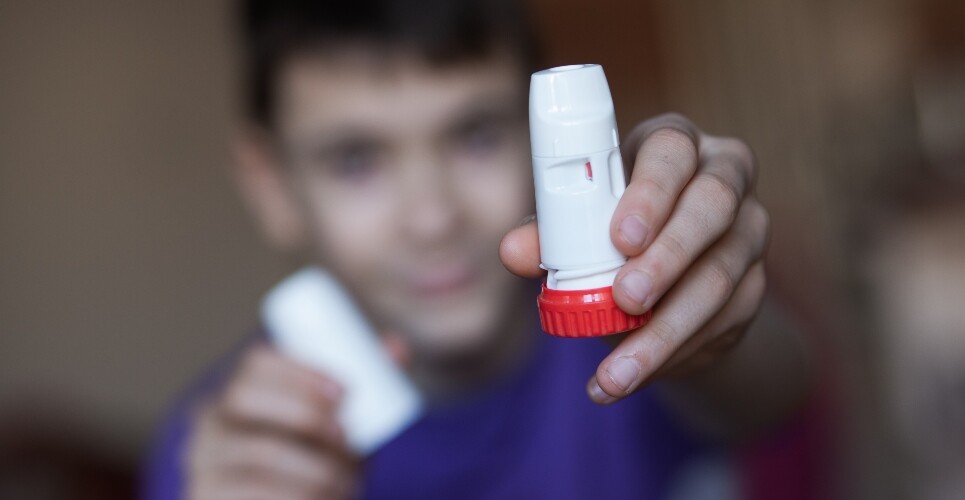
A combination reliever inhaler containing an inhaled corticosteroid significantly reduces asthma attacks compared with salbutamol monotherapy in children, a large international trial has reported.
It is the first randomised controlled trial to test the combination budesonide-formoterol inhaler that is now recommended for adults in young children.
The year-long study of 360 children aged five to 15 years old in New Zealand found the combination inhaler cut asthma attacks by an average of 45%, compared to a salbutamol inhaler.
It means that for every 100 children with mild asthma who are switched from salbutamol to a combined inhaler, there would be 18 fewer asthma attacks per year, the team calculated.
Reporting in The Lancet, the researchers, led by the Medical Research Institute of New Zealand in collaboration with Imperial College London and others, said the results showed the combined inhaler was superior against a similar safety profile for both including no difference in children’s growth in the two groups, confirming it is effective and safe for children as young as five.
Replacing SABAs with combined alternatives
Long-awaited joint UK guidelines for asthma published in 2024 recommended replacing the use of short-acting beta agonist (SABA) alone with combined inhaled corticosteroid/formoterol inhalers for as needed symptom relief in everyone over the age of 12 years.
The guidance from NICE/BTS and SIGN, brought the recommendations in line with the Global Initiative for Asthma (GINA) guidelines which had long stated that SABA-only treatment was not advised.
Researchers behind this latest trial in children said it provided the evidence to bring children’s recommendations in line with adults.
However, as the trial was done during the pandemic when there were lower levels of circulating respiratory viruses, the researchers acknowledged that the children in the study had fewer asthma attacks overall than had been predicted.
Despite this limitation, they added that the study’s findings are generalisable to clinical practice due to its pragmatic, real-world design.
A UK report last year warned that children from the most deprived areas are four times more likely to die from an asthma attack.
Overuse of reliever inhalers was one of the common risk factors in investigations of the deaths alongside emergency hospital admissions, and exposure to air pollution and cigarette smoke.
A CARE UK trial is currently assessing the inhaler in 1,300 children between the ages of six and 11 across 15 centres and is expected to run until 2027.
A game-changer for asthma
Professor Andy Bush, professor of paediatric respirology at the National Heart and Lung Institute, Imperial College London and senior study author, said: ‘Having an asthma attack can be very scary for children and their parents. I’m so pleased that we’ve been able to prove that an inhaler that significantly reduces attacks – already a game-changer for adults – is safe for children with mild asthma too. We believe this will transform asthma care worldwide and are excited to be building on this work with the CARE UK study.’
Professor Helen Reddel, chair of the science committee of GINA, said the study filled a critically important gap for asthma management globally.
‘Asthma attacks have a profound impact on children’s physical, social and emotional development and their prevention is a high priority for asthma care,’ she said. ‘It is in childhood, too, that lifelong habits are established, particularly reliance on traditional medications like salbutamol that only relieve symptoms and don’t prevent asthma attacks.’
A version of this article was originally published by our sister publication Pulse.