The British Society for the History of Pharmacy hosts a conference each year in a different UK city. For 2026, it was Edinburgh’s turn and the theme was ‘Pharmacy Communities: Local and Global Perspectives’, as vice president Catherine Walker explains in this conference report.
The annual conference of the British Society for the History of Pharmacy (BSHP) is a highlight of the BSHP calendar and provides an opportunity for networking, sharing ideas, support and socialising. This year’s conference from 8-10 May was held in Edinburgh – a city with a rich pharmacy history.
The conference is open to all, and non-members are very welcome. No experience of pharmacy history is needed, and we have hosted delegates from a range of backgrounds from pharmacists and historians to herbalists and museum professionals.
In previous years, the conference was condensed into two days – one for the conference and one for excursions. A new format was trialled this year, which saw the event extended over three days, and there was a packed programme of talks, visits, tours and social events, enjoyed by a mix of BSHP members and new attendees.
The formal Saturday conference was bookended by optional excursions on the Friday and Sunday. Dinners were also arranged in Edinburgh on the Friday and Saturday evenings, giving the group plenty of opportunities for networking, socialising and enjoying Edinburgh as a city.
Exploring the history of blood
Reflecting the rich pharmacy history in Edinburgh, the conference started with a visit on the Friday afternoon to the latest exhibition at the Royal College of Physicians of Edinburgh (RCPE) – an organisation with which BSHP has a long relationship.
Rachel Forrest, RCPE heritage engagement officer, led delegates on a wonderful tour of the exhibition Rag: A History of Blood. Highlights included:
- William Harvey’s De Motu Cordis, outlining his discovery of the circulation of blood
- A varnished copy of Breathing a Vein by James Gillray – another copy of this 19thcentury print can be found in the Royal College of Pharmacy Museum in London
- The Blood Bag Project by artist Leigh Bowser, exploring the importance of blood transfusions from the perspective of patients with Diamond Blackfan anaemia.
The exhibition explored the history of blood across three themes: blood-based discoveries, the stigma of blood myths and the history of blood transfusions and bloodletting. Delegates were able to see a Leech jar that had been loaned by the Royal College of Pharmacy, sparking a lively discussion on contemporary leech husbandry!
There was also time to see the permanent exhibition in the Joyce Grainger Learning Centre, which explores our body’s relationship to health and medicine.
A morning of talks and the RCPharm Scottish Collection
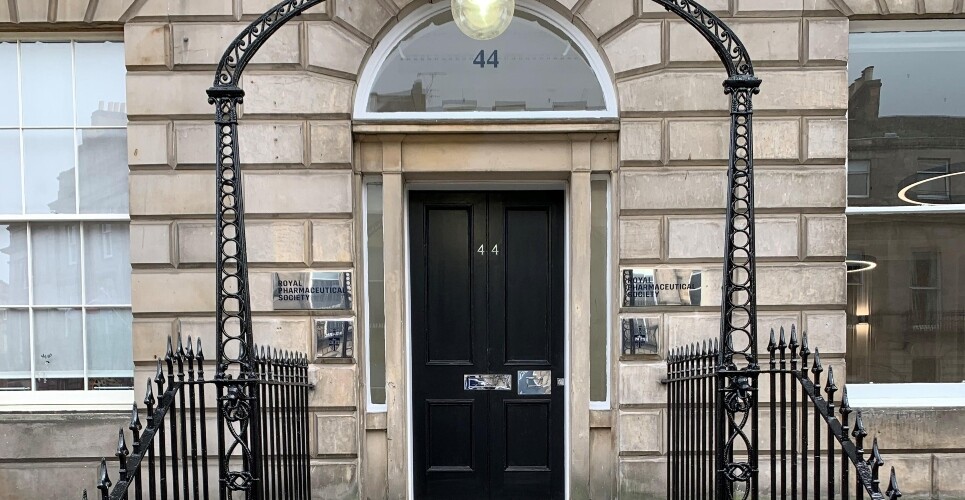
Saturday morning saw delegates meet at the newly renamed Royal College of Pharmacy (RCPharm) – formerly the Royal Pharmaceutical Society. The RCPharm office in Scotland is beautiful townhouse in Melville Street, near Haymarket.
RCPharm has been in this location since 2019, and the four-storey townhouse is made up of meeting rooms, offices and a small museum showcasing the history of pharmacy in Scotland. Items from the Scottish Collection are also displayed around the building.
After refreshments and a chance to explore the space, delegates met for a morning of presentations on short papers covering the usual wide range of research topics. These included:
- A History of Pharmacist Antivaxxers by Anthony C. Cartwright, author of A History of Vaccines and Anti-Vaxxers
- The Trajković Apothecary Family – The History of a Victim by Jelena Manojlovic MPharm, University of Belgrade, Faculty of Pharmacy
- Understanding and Constructing Apothecary Communities in 16th Century England by Elizabeth Austin
- ‘First, Do No Harm’: Charles H. Gare, Chemist and Druggist and the Murder of Joseph Oliver, 1869 by Kevin Goodman.
After lunch, delegates had further time to discover the RCPharm Scottish Collection. This collection grew separately to its London counterpart and was established as a teaching collection to support the wide work of the Society in Scotland.
The North British Branch, as it was originally named, was established in 1852, 11 years after the formation of the Pharmaceutical Society of Great Britain. Over the next 174 years, a collection of around 2,000 objects was assembled, all focusing on the history of Scottish pharmacy.
Some of the objects now on display in the Scottish Office include a beautiful 19th century drug run from a former chemist on Grassmarket, and stained-glass windows from when the Scottish Office was based at 36 York Place.
The unique Scottish pharmacy trajectory
In the afternoon delegated enjoyed two further presentations on short papers:
- A MANX Medicinal Mixture: Sharing pharmacy history with the community in the Isle of Man by Paul Richard Lewin MRPharmS
- The Medical, Pharmaceutical and Historical Significance of Peter of Spain’s Aqua Mirabilis by Dr Maria do Sameiro Barroso M.D of the Portuguese Medical Association.
This was followed by a fascinating keynote speech by Sophie Goggins from the National Museum of Scotland on Eric Knott, The Last Apothecary, and his work at the Royal Public Dispensary.
This talk reflected how pharmacy in Scotland and England developed differently. In England, pharmacy developed through a community pharmacy setting, whilst the trajectory in Scotland was focused more on infirmaries and dispensaries.
Sophie’s talk also prompted reminiscences of Eric Knott himself, and the way pharmacy education has changed in Scotland and across Great Britain in general.
The formal day closed with the Annual General Meeting, including an update from BSHP president Mark Nesbit on the new strategic plan for 2026-30. This strategy has four core focuses:
- Strengthening research
- Supporting museum, library and archive collections
- Education and dissemination
- Sustaining membership and the Society.
Impact of medicinal plants on pharmacy
The final conference excursion took place on the Sunday at the Royal Botanic Gardens Edinburgh (RBGE), hosted by Professor Olwen Grace, deputy director of science (collections) and curator of the herbarium.
Delegates were able to reflect on the impact of medicinal plants on pharmacy, some of which, such as digitalis, were cultivated in Edinburgh for manufacturers like Duncan Flockhart.
They also explored the gardens with a guided tour by Dr Gregory Kenicer, botanist at the RBGE, with a particular focus on the medicinal plants, before refreshments were served in the Botanic Cottage.
The BSHP committee would like to extend our thanks to our hosts the RCPharm for their fantastic hospitality and to our speakers for a thoroughly enjoyable programme. It was agreed at the AGM that we would investigate Norwich as next year’s venue, with more details to follow in the Autumn issue of the BSHP Gazette.
Catherine Walker is the vice president of the BSHP and museum manager at the Royal College of Pharmacy in London.
Hospital Pharmacy Europe is delighted to support the British Society for the History of Pharmacy as a media partner. Formed in 1967, the Society aims to advance education in the history of pharmacy for the public benefit, stimulating interest and promoting and encouraging research and study into the history of pharmacy within the UK and beyond via its open access journal, free online lectures, annual conference and more.