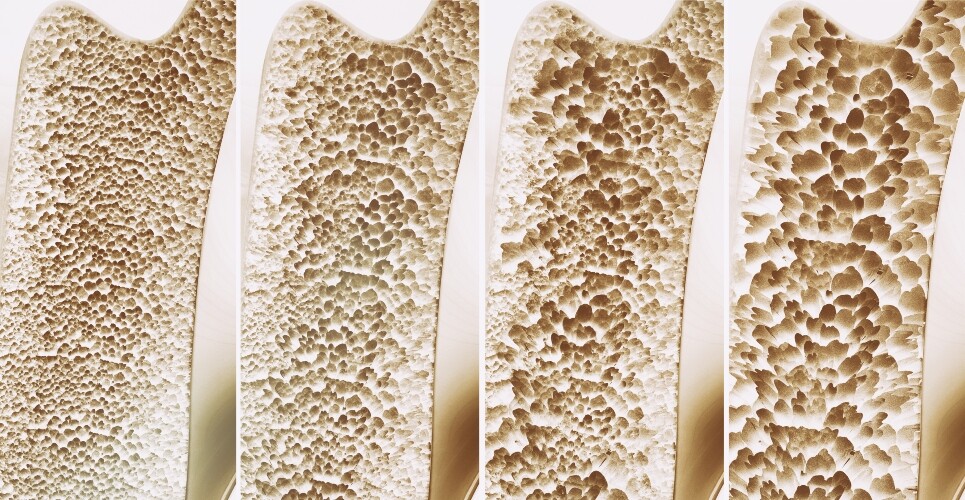
After more than a decade of international collaboration through the SABRE project, the US Food and Drug Administration recently recognised changes in total hip bone mineral density as a surrogate for fracture risk reduction in postmenopausal osteoporosis trials. SABRE investigators Professor Richard Eastell, Marian Schini and Tatiane Vilaca from the University of Sheffield, explain how this landmark decision came about and how it could accelerate the development of new therapies in the UK, EU and beyond.
Osteoporosis-related fractures, which lead to high morbidity and increased mortality, represent a large and growing public health concern.
Several treatments for preventing fractures are available, including hormone therapies; oestrogen receptor modulators such as raloxifene; antiresorptives such as bisphosphonates; monoclonal antibodies such as denosumab; and anabolic agents such as teriparatide, abaloparatide and romosozumab. However, some of these treatments can be difficult to take, may cause side effects and can be effective for only one to two years.
As fracture risk increases markedly with age and populations continue to age worldwide, the number of fractures is predicted to rise substantially in the coming decades. New therapies are therefore urgently needed.
The University of Sheffield is among the leading global centres for osteoporosis research. We have extensive experience in osteoporosis clinical trials and in the use of surrogate endpoints, including bone mineral density (BMD) and bone turnover markers.
We maintain close collaborations with internationally recognised groups such as those led by epidemiologist and biostatistician Dr Dennis Black at the University of California in San Francisco, and Dr Mary Bouxsein, a professor of orthopaedic surgery and biomedical engineer at Harvard University.
Launching the osteoporosis SABRE project
In recognition of the challenge to develop much-needed new osteoporosis drugs, our groups collaborated to launch the Study to Advance BMD as a Regulatory Endpoint (SABRE) in 2013, with support from the Foundation for the National Institutes of Health.
The aim was to determine whether a treatment-related change in BMD, specifically total hip BMD, could qualify as a regulatory surrogate endpoint for fracture risk reduction in clinical trials of drugs for postmenopausal osteoporosis.
SABRE analysed data from 52 randomised clinical trials involving more than 160,000 participants, making it one of the most comprehensive datasets assembled in osteoporosis research.
We worked with industry partners and investigators to collect individual patient data, establish a database with standardised fracture definitions, conduct statistical analyses and jointly prepare a Food and Drug Administration (FDA) biomarker qualification plan. Additional expertise was provided by data analysts, statisticians and clinical trial specialists.
What was the key evidence from SABRE?
We followed the three steps of the FDA biomarker qualification plan: determining whether the surrogate has biological plausibility, establishing whether the surrogate predicts the clinical outcome and demonstrating that changes in the surrogate predict the outcome in clinical trials.
Biological plausibility was supported by experiments on bone samples, which showed that hip BMD correlates with bone strength.
We then assessed whether low BMD in the population was associated with increased fracture risk. This association was demonstrated through observational studies and by analyses of placebo groups within the SABRE clinical trials.
We selected the treatment-related change in total hip BMD at 24 months as the surrogate endpoint. Individual patient data from more than 50,000 participants from more than 16 clinical trials were available and meta-regression analysis showed that the association between treatment-related change in total hip BMD and fracture risk reduction had an R2 value exceeding 0.65, which is considered excellent.
Together, these findings provided strong evidence for meeting the FDA’s requirements. As a result, on 19 December 2025, the FDA confirmed that this endpoint could serve as a surrogate for fracture risk reduction in clinical trials of drugs for postmenopausal osteoporosis.
An important limitation of this surrogate endpoint is that BMD measures bone quantity rather than bone quality. During drug development, it is therefore essential for preclinical studies to demonstrate increases in bone strength and that bone biopsy studies in patients show no impairment of mineralisation.
Addressing osteoporosis trial challenges
Two major challenges have traditionally affected osteoporosis clinical trials. First, because more than 10 drugs are already licensed for osteoporosis, the use of placebo controls in long-term trials involving individuals at high fracture risk raises ethical concerns and there has been limited incentive to develop new therapies despite the need for more effective options.
Second, such trials are extremely costly. For example, estimates suggest that the recent Long-term Odanacatib Fracture Trial, which recruited more than 16,000 women and followed them for five years, cost hundreds of millions of dollars.
We anticipate that using treatment-related change in BMD as an endpoint could reduce trial size to approximately 500 participants followed for up to two years, helping to overcome these barriers by making future osteoporosis drug trials shorter and less costly.
Using the SABRE dataset, we identified the magnitude of treatment-related change in total hip BMD at 24 months, which would be associated with a significant reduction in fracture risk – the surrogate threshold effect. We proposed that if the difference in BMD change between a new drug and placebo at 24 months exceeded this threshold, the drug could be considered effective and suitable for approval.
For example, a treatment-related increase in total hip BMD of more than 1.43% at 24 months would suggest that a drug is likely to reduce the risk of vertebral fractures. At present, treatment-related changes in BMD are accepted as a surrogate endpoint in men, once fracture reduction has been demonstrated in women.
While the FDA decision applies to the US, the UK’s Medicines and Healthcare products Regulatory Agency uses an international recognition pathway for rapid approval if a drug has already been licensed by a trusted regulator, such as the FDA or the European Medicines Agency (EMA).
We plan to seek EMA approval to use the treatment-related change in BMD as an endpoint later in 2026.
Balancing accelerated development with post-approval evidence
SABRE was initiated to promote innovation in the field of osteoporosis, where underdiagnosis and undertreatment of the disease are considered to have reached crisis levels.
The primary purpose of qualifying a surrogate endpoint was to replace the clinical outcome in trials. Clinicians and patient groups should therefore be reassured that a positive treatment-related change in total hip BMD indicates a reduction in fracture risk. We do not anticipate any requirement to collect fracture outcome data within these trials.
Importantly, the most serious adverse effects associated with licensed osteoporosis treatments, including atypical femoral fractures and osteonecrosis of the jaw, were not detected in large clinical trials but emerged through post-marketing surveillance. Continued engagement with pharmacovigilance systems will therefore remain essential to monitor the safety of new therapies.
Conclusion
The use of surrogate endpoints in clinical trials requires careful planning and agreement between sponsors and regulators, as well as rigorous implementation through multidisciplinary collaboration to ensure adherence to protocols and regulatory standards.
The FDA qualification of BMD as a surrogate endpoint represents a significant milestone in osteoporosis research, with the potential to make clinical trials smaller, swifter and more cost-effective while maintaining rigorous scientific standards.
With further engagement across regulators and researchers, this advance could help speed the delivery of innovative treatments to patients and invigorate investment in a field where effective new therapies are urgently needed.
Authors
Richard Eastell MD FRCP FRCPath FMedSci
Professor of bone metabolism
Tatiane Vilaca MD PhD
Clinical research fellow in bone metabolism
Marian Schini MD PhD
Senior clinical research fellow and NHS consultant in bone metabolism
All of the Division of Clinical Medicine, School of Medicine and Population Health, Faculty of Health, University of Sheffield, UK
This article was originally published by our sister publication Hospital Healthcare Europe.